Syntonic Dentiforms redux
Some 22 years ago nesnausk! made a demo Syntonic Dentiforms. That was 2004! So of course the demo was written for Windows, 32 bit, Direct3D 9, used D3DX Effects Framework, and was compiled with Visual Studio 6. It used fairly-new at the time pixel shader model 2.0 (heck yeah!), but also had fallback rendering paths for shader models 1.4 and 1.1. Good times.
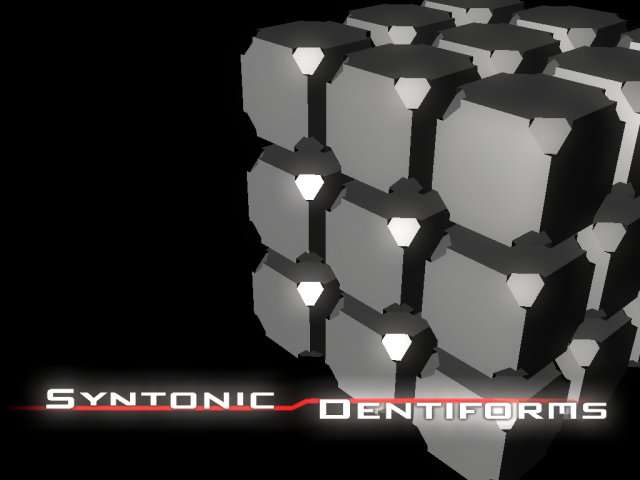
Now I took the source code of it, looked at it in horror, and rebuilt it for current platforms.
- Replaced D3D9 / D3DX with sokol_gfx,
- Replaced FMOD for audio playback with sokol_audio and stb_vorbis,
- Instead of Windows / DX9 32 bit, now it compiles for Windows / DX11, Linux / OpenGL, macOS / Metal (all 64 bit), as well as Web (Emscipten / WebGL2).
- Replaced Object-ID based shadowing with regular shadow maps, using Castaño’s 5x5 PCF filter,
- All lighting is now per-pixel (previously reflections were lit per-vertex), lighting vectors are normalized more properly and the reflections are anti-aliased.
Here are the builds and the source code:
- Web build here (please do not run on a phone in portrait orientation, thx)
- PC builds: Windows, Linux and macOS, 6MB each,
- Source code repo on github.
- Video capture on youtube:
Musings on source code
This made me realize that the code I was writing 22 years ago has been really bad, judging by my today’s standards. So. much. pointless. abstractions. and. design. patterns. and. inheritance. Out of curiosity, I tried rewriting the parts of the code that I understand (there are some that I don’t; I left them as they are), just to see how much simpler and smaller the code can get.
For example everything related to “animations” initially was this: 16 files, with interfaces, and listeners, and traits, and whatever.
IAnimChannel, CAnimChannel<T>, CAnimContext, CAnimCurve<T>, CAnimImmediateMixer<T>,
IAnimListener<T>, IAnimStream<T>, CAbstractTimedAnimStream<T>, CAnimStreamMixer<T>,
traits::anim_type<T>, IAnimation<T>, CAnimationBunch, CSampledAnimation<T>, CTimedAnimStream<T> –
just, whyyyy. All of that can be simplified into two files with way fewer parts (AnimCurve, SampledAnimation, AnimationBunch).
Same story with “graphics” or “resource loading” related parts.
So, what was 24 thousand lines of code across 216 source files, became 6 thousand lines of code across 49 files. Does anyone care? No, of course not. But I did it anyway :)
The executable became a megabyte smaller, by the way. Mostly because it was using D3DX (effects framework, texture loading, math), and I replaced them with other, smaller, libraries that do less stuff. I ❤️ sokol libraries by Andre Weissflog; they are simple, straight to the point, and let me get this working across all of windows/linux/mac/web. It is funny that back then, Andre’s Nebula Device game engine design was pretty influential for us, with all the abstractions and object-orientation. Sokol is almost complete opposite, and I love that.
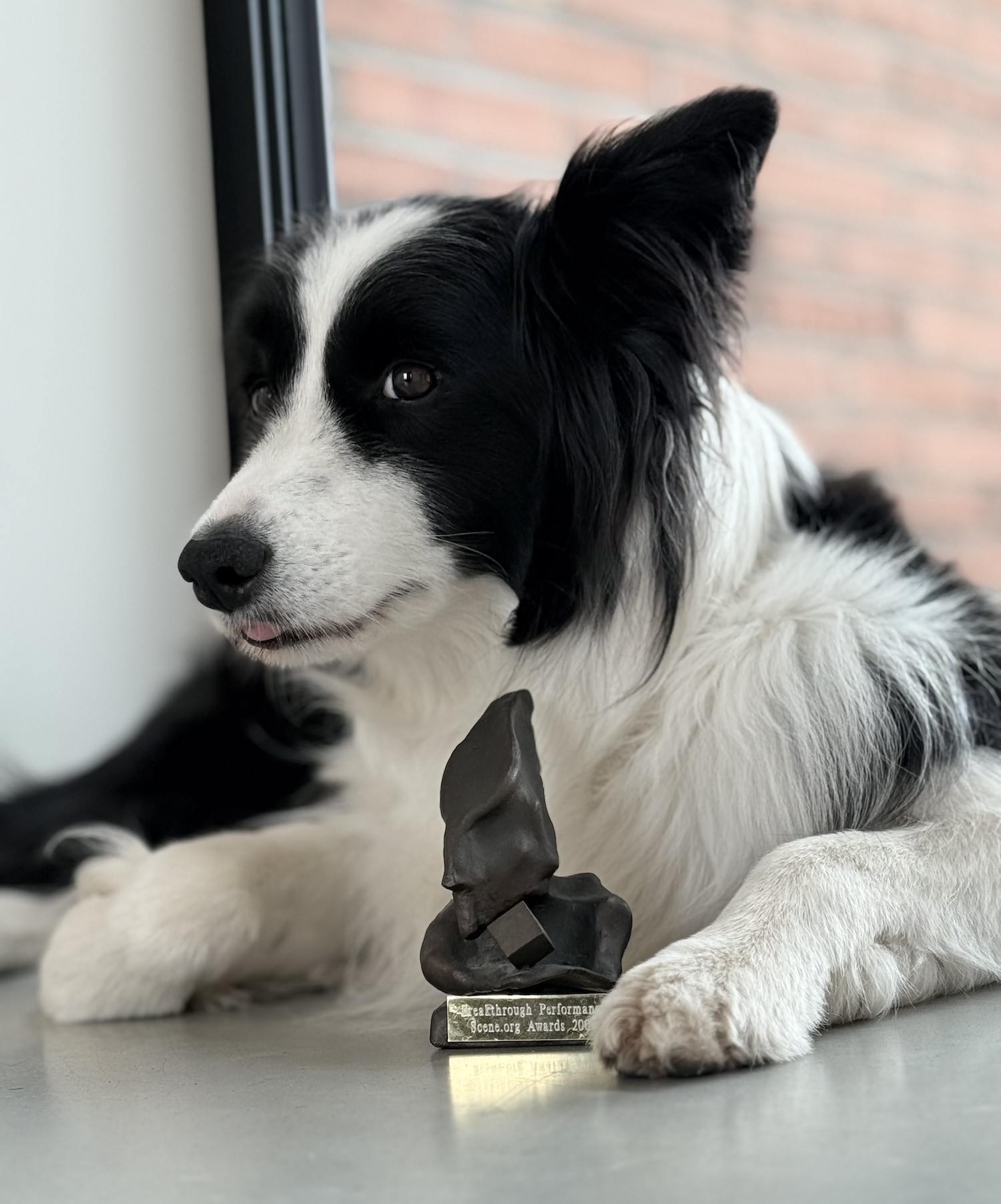
The demo has a special place in my heart since this is the first “not complete shit” demo that I worked on :) We also managed to get a scene.org Breakthrough Performance award for it! Ren here is completely unfazed by the award though. She shows that awards are just a social construct.